Sunday, May 23, 2010

CUSTER AND SURROUNDING AREAS

1. What attracted us to Custer, South Dakota, was Mount Rushmore National Memorial. The task of sculpting the faces of 4 US Presidents out of a granite mountain just seen so monumental; something we do not want to miss. We soon discovered that there were also other attractions around Custer that taken together would easily deserve more than the two days (20th and 21st May) we spent in the area. The whole area has clearly become a destination in its own right.

2. On the day we arrived, we managed to rush to the Jewel Cave, a short drive to the west of Custer, in time to join the 2.45 pm tour. First discovered around 1900, this 145 km of caves (reputedly the world's 2nd largest) are lined with jewel-like calcite crystals in various interesting shapes and forms. Amazingly beautiful. Unfortunately, my camera was not good enough to capture the details in the low light condition. Ably led by a young female warden, the scenic tour began with an elevator ride down 234 ft, then 1/4 mile of caves, up and down more than 700 steps, taking about 1.5 hour. It's well worth the visit.

3. Our plan next day was to first head for Needles Highway (Route 87) via Highway 89 from Custer, then south to Custer State Park (hopefully to see some animals), before looping northwards to Mt Rushmore National Memorial and Crazy Horse Memorial via Iron Mountain Road.

4. The drive along the 14 miles Needles Highway (Route 87) was especially scenic. It was slow driving, with many twists and turns, through rugged granite formations that protruded up like needles, along narrow roads and passing a couple of tunnels where only one vehicle could pass at a time.

5. Heading south, we had a nice leisurely drive through the 71,000 acres of rolling hills, forests and plains of the Custer State Park. Looking out for animals was one of the highlights of a trip for visitors there. Well, we manage to see a few - bison, white tail deer, mountain goat and etc.

6. At its peak, there were some 40-50 mil bison that roamed the plain of north America. With the arrival of the Europeans in the 18/19th century, they were hunted to close to extinction. With introduction of a few bison early last century, there are now some 1500 bison in the park. For the first time I saw a live bison. One can grow to 6 ft tall and weigh 2000 lbs.

7. Mt Rushmore's 60 ft carvings of US Presidents Washington, Jefferson, Roosevelt and Lincoln were sculpted by Gutzon Borglum and 400 workers between 1927 and 1941 to represent the first 150 years of American history. On the choice of the presidents, Borglum said, "the purpose of the memorial is to communicate the founding, expansion, preservation and unification of the US with colossal statues of Washington, Jefferson, Lincoln and Theodore Roosevelt".

8. As a monumental project of the arts, this project was already worth a visit. What was also interesting was how a project originally conceived as a tourism project to uplift the economy of S Dakota had turned into an object of history lessons and the imparting of values for the young Americans. The guide we had very ably explained the choice of the presidents and what each meant to him.
Today, Mt Rushmore handles some 3 mil visitors a year, and tourism is the 2nd largest contributor to S Dakota's economy. One complication though - Mt Rushmore sits on land that's contested by the Indians.

9. The response to Mt Rushmore was the Crazy Horse Memorial, located a short distance away. Commissioned by Lakota Indian Chief, Henry Standing Bear, Sculptor Korczak Ziolkowski was invited to undertake the world's largest mountain craving. Completely privately funded, he began work in 1948. Picture on the right shows the progress to date, with head of Crazy Horse completed. When completed it will show Crazy Horse on a horse with his hand stretched pointing to his land, standing more than 560 ft high. We hope it will be within our life time when we can come back and see the completed monument,

10. The next day (May 22), we drove south to Hot Springs to visit the Mammoth site. In 1974, in preparing the land for residential development, a mammoth tooth was discovered. Work was halted and excavation work led to discovery of bones belonging to 58 mammoths - 55 Columbian and 3 Wooly mammoths. It seemed 26 000 years ago the site was a sink hole which attracted animals seeking food and water and they must have fallen into the sink hole and were unable to get out. Apart from the bones, the Centre also had an good exhibition hall showing life during the mammoth era.

11. Here you see Weiping holding a femur of a mammoth. A replica of course.

12. After the Mammoth site, we headed west along Highway 18 towards Sheridan in Wyoming where we planned to do a night stop.

Friday, May 21, 2010

JOURNEY TO SEE THE US NATIONAL PARKS

1. After a tiring day of travel on board ANA and nearly 3 hrs of transit at Narita Airport, we finally landed at Chicago's O Hare Airport at 8 am on 14 May 2010. It was May but still chilly. Li Hoon and I were looking forward to seeing our youngest boy, Weiping, and to attend his graduation ceremony and thereafter to take a month long driving holiday with him before he starts work with Towers Watson in Chicago in early July. Weiping was there to pick us up at the airport with his proud possession, a newly purchased 2 year old Hyundai Elantra. It was a easy 2 hrs drive to Madison, Wisconsin.

2. The graduation ceremony was held on 15 May in a packed Khol Center, with graduating students on the stadium
floor and the parents filling up the tiered seating. Here's the happy parents with the boy.


3. At Madison, we stayed in a charming B&B called Arbor House, a beautifully conserved building dating all the way back to 1853, near to the University's Arboretum. At and around the Arboretum there were people fishing, walking, jogging and cycling. Cycling lanes and tracks are well provided here in Madison, making cycling popular and safe, something we can learn in Singapore. We enjoyed our morning walks around the lake. Wild flowers were just as lovely.

4. The visit to the Madison Saturday Farmers Market around Capitol Square was one of the highlights of our stay at Madison. Around the Square, the pedestrian walks were packed with stalls and people. It was clearly a Saturday outings for families here in Madison - young and old, parents with their little kids. I just loved the many very colourful flower stalls.

5. At 10 am 18 May we set off on our driving holiday. Here we are at Arbor House before we departed.

6. In this month long 4000 miles driving holiday, we plan to visit the Custer State Park (to see Mt Rushmore), Glacier National Park, Yellowstone National Park and Rocky Mountains National Park before we head back to Madison to help Weiping make his shift to Chicago.

7. Our first destination, Custer State Park, was more than 700 miles away. As we would only travel in the day, we decided to make 2 night stops - St Paul in Minnesota and Pierre in South Dakota.

8. We got to St Paul comfortably by about 5 pm. After checking into Ramada Inn we have more than enough time to take a stroll in the Mall of America, the largest shopping mall in the USA, with more than 2.4 mil sq ft of space and 900 shops. It is big enough to have a theme park in the middle. I last visited this mall a few years ago, as part of STB study trip to the USA.

9. Out of St Paul, along Highway 14 to Pierre, there were unending corn fields on both sides of the road, stretching far out to the horizons. I had not seen so much corn fields in my life. At this time of the year, the corns had been harvested. The scenery reminded me of Michael Pollen's book, the Omnivorous Dilemma. Along a stretch we were surprised to see many wind mills - must be hundreds of them. Glad to see that there is a serious attempt to harness clean energy.

10. With a population of about 780 thousands people, South Dakota is one of the most sparsely populated state of the USA. Along Highway 14, we passed through big and small towns, mostly small. Before entry into each town, a signboard would display the size of its population. We found it hard to believe when we saw "Cottonwood, Pop 12".

11. Pierre is a lovely small town, the capital of South Dakota. After checking into Day Inn, we took a stroll along the banks of Missouri. Its clean and green. Beautiful environment.

12. After Pierre, we continued our journey the next day along Highway 14 towards Rapid City. The ground has become more undulating and corn fields have given way to cattle grazing fields. As we approached Wall, we started to see numerous signboards on both sides of the road advertising Wall Drug Store. We told ourselves, "since they are so determined, we will stop by to have a look and maybe have lunch there".

13. Located at the junction of Highway 14 and Highway 90, the Wall Drug Store looked a fairly successful business enterprise. It had shops catering to needs of tourists and a cafe with 530 seats. During peak season, it could handle up to 20 000 customers a day. Its early history however paled in comparison, according to the brochure on the Drug Store. When Dorothy and Ted Hustead bought the drug store in 1931, it was in the middle of nowhere. For the first 4-5 years, business was poor but faith kept them going and they refused to give up. Travelers would pass by but hardly anyone dropped in. Until one day, when Dorothy came up with an idea of how to get those travelers to come into their store. She recognized that the travelers, after the long travel, were thirsty and what they badly needed was ice cold water. They decided to put up signs on the highway telling people to come for free ice water. It worked and business took off.

14. To me, this is an inspiring story. It tells us not to give up easily when faced with difficulties. Don't be afraid to try different solutions. There is nothing to lose. One of them may just work.

15. We reached Custer at 1.30 pm and managed to check into the B&B that we had booked beforehand - Custer Mansion. Pat and Bob, the husband and wife team, run this place. A very hospitable couple, they had us settled down very quickly into our rooms, and guided us on what to see and do in the area. Already, we started to feel that maybe a couple of days was not enough.

Tuesday, December 29, 2009

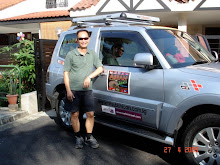
PAJERO IS HOME

1. At last, the Pajero is home. The car arrived in Singapore in a container from Surabaya on 25 Dec. Collected the car from Keppel Distripark yesterday, 28 Dec - the first working day after the festive weekend. With Yong Peng of Toll Logistics with me, it was a breeze clearing Singapore Customs and getting the car out of the Free Trade Zone. Its unpacking today.

2. There are still 2 countries outstanding in my Asean on Wheels journey - Myanmar and Philippine. I am not sure about the possibility of Myanmar, as I made hardly any headway since I put the request early this year to the Myanmar Embassy here in Singapore for a self drive holiday in Myanmar. The prospect of doing a trip to Philippine was looking promising as Philippine Department of Tourism was helping with getting the necessary approval for me until I decided to drop Philippine in the last trip due to insufficient time. I will have to start exploring this again, some time next year, 2010.

Friday, December 25, 2009

IS IT SAFE?

1. Knocked into a friend today and we started talking about my Asean on Wheels self-drive holidays. I was asked: is it safe? I had been asked this question umpteen times since I embarked on this self-drive holiday in April this year. So I thought perhaps I should just write a few paragraphs about this and share my thoughts.

2. The truth is, in the nature of things, there are always risks. Is it possible that we may be mugged or kidnapped? Or car broken in and things inside stolen? Or worst, car get stolen? What about terrorist attacks? We cannot rule out such incidents could happen to us. Are the risks higher in the places that we traveled to? Not necessarily so, I feel. Often, it is an issue of perception. Our impression of a foreign land is often shaped by negative news reported by the media. We forget that there are zillions of activities going on in that land that are not reported (i.e not news worthy) that represent the state of normalcy. When we push ourselves into greater unknown, it is natural that fear factor goes up and this may have little to do with the level of risks. We decided that a practical approach to take was risk minimization not risk avoidance. We could not afford to have fear paralyzed us into inaction.

3. We did a number of things to reduce our risks:
(a) First and foremost, we tried to do all our driving in the day. It is much harder for someone to stop the car and rob you in broad daylight. Also, it minimizes the chance of traffic accidents. In our travels, we came across many motorcycles and bicycles that traveled at night without lights or reflectors. It was a real strain trying to spot them in darkness. By the way, many roads were without street lights.
(b) As a norm, we looked for hotels with its own car-park, preferably with 24 hrs security. We avoided street parking.
(c) In general, we retired early, often to clear emails and to blog, and to get enough rest for travel the next day. We avoided clubs and pubs, rowdy places where tendency for incidents was higher.
(d) As ATMs were everywhere, we carried as little cash as possible. Also, we spread the cash between the two of us and put them in various places in the car.
Additionally, I would have loved to travel with 2-3 cars but it was not possible these times.

4. We covered extensive ground in the 2 trips, about 24 000 km over 130 days, to Malaysia, Thailand, Laos, Cambodia, Vietnam, Brunei and Indonesia, staying nights in more than 80 towns and cities, but there was not a single moment when we felt unsafe or threatened. It does not mean there was no risk. But, it could possibly mean that the level of risks was not as high as many people feared. Very often, we drew quite a fair amount of attention and were stared at. They were not hostile stares. Some of them would peek into the car. They were mostly curious people, wondering where the foreign car was from and what it was doing in the country. One of them in Lombok was so interested in the Pajero that he asked if I was prepared to sell the car. In Ho Chi Minh City, we were stopped by a policeman because he wanted to find out how much my Pajero cost.

5. We had consistently come across friendly local people who were always ready to help. If there is one important lesson I learned from these trips, it is: Never be afraid to ask. I was often surprised by their eagerness to assist. One day in Ubud in Bali, I had the misfortune of reversing my car into a drain, near to a village. Two of the wheels were left dangling over the drain. Within minutes, the noise drew some 10-15 males from the village to my car. Very enthusiastically, they helped lift the car on one end while I turned the car forward with the gear in high torque. When we got the car out of the drain, they all cheered in unison. It speaks volume, of their friendship and their preparedness to help.

6. It is in trips like that that we come to appreciate that there are many ordinary people out there, though different, actually are not too different from us. Often, they are warm and friendly, hospitable because we are guests to their country and would lend a helping hand when asked.

Wednesday, December 23, 2009

PAJERO ON WAY HOME

1. Received the good news from Calvin and Glenn of PT Freight Forwarders in Surabaya on 21 Dec that the Customs had given its okay for the shipment of my car back to Singapore, after it received the required document from Entikong Customs. In parallel, Diyah of IMI also sent me a copy of the document from Entikong Customs.

2. The car was stuffed into the container yesterday. The ship is scheduled to depart today and arrive in Singapore on 25 Dec. Hopefully I can get my car home on 26 or 27 Dec.

3. It had been a tedious process of getting Surabaya Customs to clear the reexport of my car back to Singapore. Staff of PT Freight Forwarders must have spent many hours waiting at the customs office and pushing the customs staff there. In particular, I would like to thank Calvin Siddons, who had also kindly agreed to have my car parked in his house while waiting for clearance, and Glenn Ricardo, who had infinite amount of patience and energy to keep pushing. I cannot afford to forget to mention Diyah of IMI (Ikatan Motors Indonesia). She had been extremely patient and accommodating, acceding to my various requests as changes were made to my travel plan. At home, Pak Iskandar, Mulyana and Nugraha of the Indonesian Embassy in Singapore were most helpful in helping us steer through the paperwork. Also, Kee Sin and Yong Peng of Toll Logistics were always ready to chip in and help, and my friend, Bee Lan, helping to monitor and cover the gaps here and there.

4. To them, many thanks, and to all, Merry Christmas and a Happy 2010.

Friday, December 18, 2009

BACK IN SINGAPORE

1. Happy to be home in Singapore, Day 65 of the trip, 17 December. Woke up at 3.45 am to catch the China Airline flight at 6 am from Surabaya. It must be the last remaining flight that still had seats going to Singapore from Surabaya; possibly because it was the least popular due to its ungodly departure time. But, it was impossible to get a seat on the other flights; so we had no alternative if we want to get back to Singapore soon. It is holiday season and the seat situation is not likely to get better.

2. Unfortunately we left without resolving the shipment of the Pajero back to Singapore. It is now parked in Calvin Siddon's house in Surabaya waiting for Surabaya Customs to clear the re-export of the car back to Singapore. Calvin is the GM of PT Freight Express, the company handling the shipment of my car in Surabaya.

3. Basically, we are still stuck with the customs paperwork at Surabaya on the re-export of the car. The day before, 16 Dec, Glenn and I went to the Port Customs office as we had an appointment to see the Director General. We were told that he had to give his special approval as they had yet to receive the document from the Customs in Entikong, my port of entry. This was news to us as we were under the impression that only a new IMI letter was needed and this was promptly sent by IMI last Friday. According to the customs procedure, a document is needed to be sent by the port of entry to the port of exit before the exit port grants the re-export. And this is needed despite the Carnet properly endorsed by Entikong Customs. With modern communication, one would expect that this could be done fairly quickly through email, fax or telephone. But, we had waited a week and are still waiting. At any rate, we left very disappointed. We left the Director General's office without seeing him, as he told his staff that no meeting was necessary as the procedure had to be followed and we just had to wait for the document from Entikong Customs before the car could be stuffed into the container and shipped. Period.

4. I repeatedly told Mr Yudi of Surabaya Customs that as I entered Indonesia legally through Entikong, as shown by the Carnet endorsed by Entikong Customs, and I had documents to prove that I am the owner of the car, I had every right to bring my car back to Singapore. Even if Entikong Customs did not follow the procedure fully, this was an internal matter for the Indonesian Customs to handle. Since the Indonesian Customs was not about to confiscate my car for the reasons above, it should deal with the internal matter separately and should not delay the shipment of my car back to Singapore. I received no response each time I explained this. It could be that Glenn's interpretation was not good enough; but I doubt it.

5. I decided that I had enough of the waiting; first it was the IMI letter, then the document from Entikong Customs. And I had no commitment from the Customs there how many more days I would have to wait for the re-export approval. I reckon I am not going to sit around and wait for the Indonesian Customs to sort out its internal procedural requirements.

6. I am now leaving my car in the good hands of Toll Global Logistics and PT Freight Express to find the most expedient way to ship the car back to Singapore for me.

7. It was an unproductive week in Surabaya. The time could have been better spent seeing more of Java. But, out of necessity, we had to eat and we found ourselves going back to these 3 places as they serve great local dishes at great value: Bon Amis, Bu Kris and Indo Laut Seafood. We have a simple rule - go where the locals go if you want good food at great value; and we were not disappointed.

Tuesday, December 15, 2009

STILL WAITING, TO SHIP CAR BACK

1. Have been in Surabaya since Thursday, except for a weekend trip to Tretes, a hill resort about an hour drive from Surabaya, waiting for the Customs to approve the re-export of my car back to Singapore.

2. At Surabaya, Freight Express, the local partner of Toll Global Logistics, is helping with the shipping of my car from Surabaya to Singapore. Last Friday, I followed Glenn Richardo and Rudy of Freight Express to meet with a Mr Yudi from the Surabaya Port Customs. After Glenn explained to Mr Yudi our requirement, Mr Yudi pulled out a printed document and explained to us in Bahasa (Glenn interpreted) the regulatory requirements governing the re-export of the car. After browsing through our documents, and after we explained to him the Carnet, he said Surabaya Customs did not receive the letter from IMI, which according to the IMI letter, a copy was sent to Surabaya Customs. According to the regulation, he said that the IMI should have included a Police permit for my self drive holiday in Indonesia and a travel itinerary. As I had already ended my trip, he agreed that it was pointless getting the Police permit. He lamented that Entikong Customs should have pointed this out. He said that he would consider approving the re-export if IMI issues a new letter that would address the issue of Police permit and include my travel itinerary.

3. On the same day, Diyah Yanuardani of IMI was so kind to write a new letter to Surabaya Customs supporting the re-export of my car. As Yudi was out for meeting the whole day of yesterday (Monday), we are still waiting for him to approve the re-export licence. Glenn hopes to catch him the first thing in the morning today. Once done, we could then proceed to stuff the car into the container, in time for the ship departure on 17 Dec.

4. Over the weekend, Li Hoon and I decided to take a short trip to the nearby hill resort of Tretes. We were exploring Batu but settled for Tretes as it was nearer. At about 700 m high, we were looking forward to the better and cooler air up on the hills at Tretes, as against staying put in Surabaya. A convenient weekend getaway for residents in Surabaya, Tretes (and nearby Trawas) has many hotels. The trip took 2 hours and we arrived at Tretes at about 1 pm. The traffic jam at the Sidoarja Mud Pool south of Surabaya slowed us down by about an hour. After scouting around, we checked into Royal Tretes View Hotel for 560 000 Rp (US$60), inclusive of breakfast, afternoon tea and dinner. We liked the view from the room and the friendliness of the staff (in the picture are Tanti and Ais, 2 of the very friendly ladies). Hotel looked busy and we were told there were 150 government officials there for a meeting.

5. It was reading, more scrabbles and just lazing around for the rest of the day. Food, unfortunately, was disappointing - cold and certainly not salivating. On the positive side, it had a 4 man band playing during dinner time, playing English and Indonesian songs. Not bad at all, while we ate and played scrabble.

6. Woke up early the next day to visit the nearby Kakek Bodo (literally mean Stupid Grandfather) waterfall; a short drive from the hotel. We were surprised to see the same band getting ready to play. We were even more surprised when it started to play at 6.30 am, blasting away the music from the electric guitars and the drummer happily banging away the drums. I was sure it was a very effective wake up call for all the guests in the hotel. I asked the receptionist why so early. She said it was to entertain guests when they had their breakfast. Thought it would do the hotel more good if it put more focus on food instead.

7. It was a 300 m easy walk up the hills from the gate to the 40 m high Kakek Bodo waterfall. Lots of trees and greenery along the footpath, and food stalls were been set up for the day. It was Sunday, and they must be expecting a good crowd. Young boys and girls were already there, with more arriving; mostly young couples. Looked like it was a favourite place for boys to bring their girlfriends. Swimming was not possible at the waterfall. However, the attraction had a swimming pool near the entrance, which already attracted a group of boys, playing in the pool with their clothes on. We did not loiter long at the waterfall, as there was nothing much to do other than swimming in the pool which we had no intention of doing.

8. On way back to Surabaya, we decided to take a route across the hills through Trawas, Mojosari, Pugging and Krian, bypassing Sidoarja Mud Pool. It was certainly a much more pleasant drive; a scenic drive across the hills and passing paddy fields, without having to contend with the frustrating slow traffic at the mud pool area.

9. We have put ourselves for flight out of Surabaya on Thursday, 2 days from now; keeping our fingers crossed that the customs procedure would be sorted by then.