Showing posts with label Tachileik. Show all posts

Sunday, June 14, 2009

GOLDEN TRIANGLE

1. The next morning (11 June, Day 46), we decided to explore more of Tachileik, beyond the few hundred meters around the border bridge. After breakfast at 8, we strolled to the border bridge and were immediately approached by a young man offering tours in his tuk-tuk to various attractions depicted on a card he was carrying. He quoted a price of 100 baht and settled quickly for 80 bahts when we counter-offered. .

2. Included in our short tour were visits to 2 temples: the Township Dhammayon Temple and Tachileik Shwe Dagon Pagoda. Without a tour guide and the tuk-tuk driver speaking little English, our visits were brief and cursory. Dhammayon Temple was not big but very well maintained. I particularly liked the 12 wall murals inside the temple. They were beautiful, depicting the life of Buddha from the time he was born to his enlightenment. Included in each picture frame were explanations in English too. I understand the Tachileik Shwe Dagon Pagoda was modelled after the Shwe Dagon Pagoda in Yangon, the most sacred Buddhist pagoda for the Burmese. We took off our shoes and put the shoes in the rack (fee 2 bahts) and spent some time walking the temple ground. From the temple ground, we had a good view of the town. Tachileik town was fairly sprawling, contrary to our original impression that its a one street town. We could see many temples, a church and a golf course. On the wall of one of temples was a large board explaining the evolution of Buddha teaching, the emergence of Theravada and Mahayanan Buddhism and the spread to Buddhism eastwards to many countries in Asia. This was in English, so we could read. Not knowing which day I was born, I did a short prayer and put in a donation into the donation box at Tuesday Buddha, as it was Tuesday that day. There were few devotees at the 2 temples, only handful in Shwe Dagon temple, and hardly any monk. They must be out collecting alms, as we saw many on the streets on the way here. Internet research gave little information on the 2 temples even though theres wealth of info on Shwe Dagon in Yangon. Outside the temple compound, the driver pointed to the only tall building in the landscape and said its a casino. When asked, he said that the town has 3 casinos.

3. Our next 2 visits were visit to a minority village and a gem workshop/shop. We proceeded to the minority village but told the driver to cancel the visit to the gem workshop. Located just outside a casino, the minority village was nothing but a merchandising stop. We paid 140 bahts to get in, took a few pictures and left. Our arrival at about 9 stirred the whole place to life, as the people started to put on their traditional dresses. Once outside, we told the driver that we wanted to go and see the casino up the road about 300 m away (which was in the complex called Regina Golf and Resort). He was initially hesitant but we insisted. At the gate, the security lifted the bar and welcome us in, no question asked. It was just a plain building, nothing indicating that it was a casino. At the entrance to the building, we were again welcome in. Going in it was not obvious that its a casino until we went downstairs to the basement. There were about 20-30 tables, largely Baccarat. Cant tell if people there were Thai or locals. We decided to play a small sum for fun. The currency used was baht. When we wanted to change US$50 to chips, the staff asked for ID as it involved currency exchange and law required them to see our ID. As our ID was kept by the hotel we decided to take 1000 bahts and try our luck. In less than half an hour we contributed the whole amount to the revenue of the casino. On the way out of the complex, we stopped to take a look at the golf course. Looked pretty well maintained, but quiet, could only see 1 flight. I supposed the golf course could attract golfers and golf tournament who could stay in the hotel and also gamble. We were also told that the minority village was developed by the same owner who developed the Regina Golf and Resort.

4. The tuk-tuk brought us back to the hotel by 10.45. After checking out, we walked to the border crossing bridge. Passing the snooker table "saloon", we decided to have a best of 3 games snooker game. Here they played 6 red balls (as against the normal 15), so the game was much faster. Sunny was in top form, I lost 2-0. Immigration out at Myanmar end was easy. They took out our passports and stamped and returned to us. Thai immigration was like any other immigration, straightforward. We were out of the border crossing by 11.30 am.

5. After paying 80 baht for carpark at Wang Thong Hotel, we were on the road again. After some discussion, we decided to go and see the Golden Triangle. In our map and according to Miss G this was given as a single point. Our guess was that this must be one vantage point where we could see the 3 countries. Also, theres a Hall of Opium in the Golden Triangle Park that we wanted to visit. To get there, we headed for Chiang Saen, a short distance from Mae Sai. Along the way, we saw quite a few resorts, a number of them looked posh. Opposite the Hall of Opium was one- Anantara Resorts and Spa. We decided to go in and have a look. Perched on the hilltop, the resort overlooks the Mekong and the mountains of Laos and Myanmar. A beautiful resort but one beyond our budget. Cheapest was US$200 a night.

6. The Hall of Opium is one of the best museums we visited in our trip so far. It is located in the Golden Triangle Park, together with the Greater Mekong Lodge. Established by the Mah Fah Laung Foundation and sponsored by the King's mother (her photo was prominently displayed at the entrance) the museum spans an area of 5 600 sq m. Divided into many halls, it explains how the poppy plants were grown to produce opium, the 5000 years history of how opium was used, first for medicine and then how it was abused, the growth of the opium trade from 900 crates a year to 50 000 crates a year by the British East India Company, how it figured in the world trade in the 19th century (a very good chart showing the trade flows across the continents), the opium wars and the unequal treaties imposed upon China leading to the ravages of the summer palace (with beautiful wax models of Lin Zexu, Emperor Dao Guan, Queen Victoria, William Matheson etc), effects of drug abuse, rehabilitation efforts, as well as efforts to help farmers convert their crops to other cash crops. A very fascinating museum. After paying a ticket of 300 bahts, we were led to a dimly lighted tunnel that connects to the main building of the museum on the other side of the hill. Possibly about 100 m long, the walls are sculptured with distorted bodies and faces of opium victims. Quite scary really, but impactful. Exhibits were complemented with many AV shows. On the section on East India Company's role in the spread of opium, Singapore was mentioned as playing a role in the shipments between India (where poppies were grown) and China, including pictures of Raffles and a Singhapura landscape. The museum is a must see if you happen to be near the area. If not for the fact that it was already 2.30 pm, we would have stayed longer. Unfortunately no picture taking inside the museum. Later, we saw another attraction called House of Opium but we didnt have the time for another one.

7. After lunch at the restaurant near to the Golden Triangle Park, we proceeded along the road with road signs leading us clearly to the Golden Triangle. After passing the big Buddha beside the road we turned left to go up the hill to the lookout point. From this point on Thailand, we could see the Mekong, and the mountains of Laos and Myanmar, an area called the Golden Triangle which was notoriously known for growing the poppies and the distribution of drugs to various parts around the world. Today, this area is promoted for its tourism appeal. We could also see efforts by governments to help farmers convert their land to other cash crops, eg. coffee. In our travel in NE Laos, there were signboards showing joint efforts by the Laos and PRC governments. In Thailand, the royal family was actively involved in such rehabilitation efforts. In this banner at the hill top, it says "Mekong...our river our life".

8. Time was 4 pm and we decided to head straight to Chiang Mai to spend 2-3 days there. At about 250 km away, along Highway 1 and then 120, we reckoned we could make it before last light especially when roads are pretty good in Thailand. We did make it to Chiang Mai by about 6.30 and with the help of Miss G found Royal Pennisula Hotel. At 900 bahts a night, with wifi and basement carpark, it was not a bad deal. We had noodle soup for dinner at a shop near the moat. On the way back, we stopped for a drink at the Real Mexican Restaurant. Here you see Sunny relaxing over a margarita.

9. We planned to stay another 2 nights in Chiang Mai before we depart for Mae Hong Son on Monday, 15 June, to take a loop along the Thai-Myanmar border before heading for Sukhotai.

10. Overall, we were happy that we had departed from our plan to stay a night in Tachileik, to catch a glimpse of Myanmar. Other than the persistent touts, the visit was generally pleasant. We did not feel insecure even though the streets were dark at night. People were somewhat reticent but they were helpful and polite when spoken to. We were surprised that we could get by with Mandarin in some situations. They could be migrants from Yunnan or descendents of KMT soldiers who settled here after they lost the war to the communists in China. Thai baht is the de-facto currency. I dont know why the immigration had to keep our passports but I hope in due course they will free up.

Saturday, June 13, 2009

ONE DAY THREE COUNTRIES

1. At about 9, 10 June (Day 45), we began our journey to Huay Xai in NE Laos, 520 km away, to take a ferry to Chiang Khong, Thailand. We had chosen this crossing point because of its proximity to North Thailand, which was where were heading next. It also gave us a chance to explore the NE Laos. We had to first back track along route 11 to Udomxai, 200 km away, and head further NE for 100 km to Nuidui (or Na Toei) where it then forks, one to Boten, the border crossing to Yunnan 30-40 km away and the other to Huay Xai.

2. At Udomxai we had lunch at a restaurant run by a Chinese from Yunnan. He came to Udomxai 10 years ago to start up a education business teaching Chinese to largely huachiaw before opening the restaurant. He had 2 busloads of tourists from Yunnan each day lunching at his restaurant, providing the base load for his restaurant business. He told us that theres a Chinese city about 300 m up the road and Udomxai had a large Chinese population. He cited a figure of 200-300 thousands which we could not believe since Lonely Planet put the population of Udomxai to be 80 000.

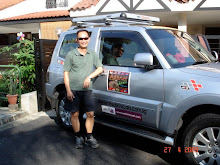
3. The road from Udomxai to Nuidui was even worse than the stretch from Luang Prabang to Udomxai. Its in a state of disrepair, with many potholes. Nuidui was hardly a town but we were pleasantly surprised with the quality of the road from here onwards. It was much better than other roads that we had travelled in Laos. The picture on the right showed the road ahead to Boten and a right turn to Huay Xai. The road to Huay Xai, Highway 3, is a high quality road, one lane either way, sealed with proper markings and shoulders, as good as highways in Thailand or Malaysia. However, we could see signs of earlier landslides and work in progress to repair them. For the first 120 km, this was not a major problem, and travel speed was still good, averaging 70-80 km per hour. Here you see me smiling as I was enjoying the drive along this road. There were more areas under repair than proper sealed road in the last 80 km to Huay Xai but travel speed was still not bad, averaging 50-60 km per hr, as efforts were made to smooth out the road so that travel speed was not too badly affected. However, minority villages still lined the road in many places and we had to be careful with animals, children and etc. This slowed us down somewhat. Quality wise this is a good road, potentially of highway standard (esp when the repair work is finished) but the adjacent villages limit the speed of travel on this road. One important observation: there was no petrol station over the 200 km between Nuidui and Huay Xai.

5. We encountered more trucks than cars along this road. With the vehicle crossing point at Chiang Khong/Huay Xai and the quality of road to Yunnan, Chiang Khong/Huay Xai is now the main crossing point for trucks in Northern Thailand heading for Yunnan in China.
Visitors travelling from N Thailand could cross to Huay Xai and take a slow boat or speed boat to Luang Prabang. We saw many falangs in Huay Xai. Chiang Khong/Huay Xai crossing point had now become one of the favourite backpackers trails.

6. We were happy that we were doing good speed along Highway 3 and we decided to press on to Huay Xai. Got there at about 8 pm and after checking couple of hotels checked into Thanomsuv Hotel for 400 bahts. Had dinner at a river side restaurant next to the Mekong and had an enforced early rest as hotel did not have internet. Next morning we took a walk in the morning market hoping to see if we could buy the BBQ/steamboat utensils. Saw one but decided against buying because we thought the depth of the utensil was too shallow.

7. After checking out, we proceeded to look for the vehicle ferry point, not quite sure about the immigration arrangements as there was a separate passenger crossing point about 2 km away. Following the sign that says "Barge Point", we found the ferry point. After referring us from building to building, we eventually found the customs office. After promptly stamping the Carnet, the customs officer referred us to an office down the slope next to the water to get the document signed. Eventually we found customs post. They were located in a shed next to the loading point. The officer asked to see the Pajero and Sunny proceeded to drive the car down. He continued to study Carnet document. We were relieved when he filled up the details and endorsed the Carnet document accordingly.

8. We were told to get immigration done a the passenger boarding point about 2 km away. We got there quickly in the Pajero. Immigration was straightforward. After the passports were stamped, we returned to the ferry point in our Pajero. Sunny bought the ferry ticket for 1000 bahts. We did not have to wait long to board the ferry and be on the way to Chiang Khong. All this while, our passports and Carnet had been stamped for exit and we were running around in Huay Xai. Over time, the Laos authorities may have to regularise the locations of the ferry and immigration points.

9. The 400-500 m trip on the Mekong was over very quickly and we landed on Chiang Khong. A very friendly Thai customs officer gestured us to wait to allow the trucks to pass first. He then asked us to clear immigration at the jetty before seeing him. When done, he asked us to get into the car and follow him in his motorbike to the customs office (can see him in his motorbike on the right) about 1 km away. When we entered the customs office next to the Mekong we were greeted by a customs officer who looked like the person in charge there in Chinese. We replied in Chinese but was quick to tell him that we were Singaporeans and was there to sort out the vehicle entry into Thailand. I passed him the Carnet, passport, vehicle log card and international driving licence, and he immediately had one of the lady staff to work on it. The officer was an impressive chap. Speaking fluently in Chinese and English, he said that he earlier worked in Sadao and had the chance to meet many Singaporeans. He had good rapport with his staff and interacted with them easily. Although I had the Carnet, the lady officer keyed in the details, like what was done earlier when I entered at Sadao, and produced a computer print out. This way, I supposed the details could be tracked easily by the customs network anywhere in Thailand. She also had the Carnet completed and kept the counterfoil. We were done by 10.30 am, in record time. I was impressed with the professionalism and service quality of the staff at this Chiang Khong customs office.

10. We next went into town to see if we could buy an insurance for the car. After some time, we tracked one down an agent for Liberty Insurance and paid 300 bahts for 3 mths, providing for coverage against personal injuries, not damage to cars. Soon, we were on the road to Chiang Rai, hoping to make it for lunch there. About 70 km away, with good road, we were there at about 2 pm and with the help of Miss G (GPS), we had a steam boat lunch at Hotpot, 179 bahts per person, eat as much as you like; great value.

11. At lunch, after discussing various options, we decided to head for Tachileik, Myanmar, and spend the night there. It was about 3 pm and the border crossing was 60 km away, we reckoned we could still make it in good time. As we already had the visa for Myanmar, we felt it would be great to get a glimpse of Myanmar now that we were so close. Once decided, we got going very quickly and reached Mae Sai, the border town on the Thai side, at about 4 pm. Left the car at Wang Thong Hotel carpark, just next to the border crossing, for overnight parking and with a backpack each we proceeded to enter Myanmar.

12. Immigration on Thai side, as expected, was easy; just stamped and go. Heres a arch for tourists to take a picture to say that they have been to the Northernmost point of Thailand. On the Myanmar side, we were shown to a room that says "foreigners". The first officer at the desk next to the door looked at our passport and very briefly look at the visa and lifting his head he asked if we like Myanmar. Speaking in no uncertain tone, I said yes and thats the reason we were coming to see Myanmar. Next he said we needed to pay 500 bahts processing fee for entry to Myanmar. After paying, he gave us a card and asked us to proceed to the officer at the 2nd desk with a computer. The officer keyed in the relevant details into his computer and the printer automatically filled up the card. With the completed card and the passport we went back to the first officer. After confirming that we were spending 1 night in Tachileik, he stamped on the card accordingly, tore out a portion of the card and gave to me and gestured that its done. I asked him what about my passport. He said that it would be kept by them and would only be returned to us on our way out. The portion of the card would be our ID while in Tachileik. This is the first time I had my passport kept by the immigration authority of a country.

13. Walking down the road out of the immigration building we came to a circle with a sign that says, "The City of Golden Triangle". Very soon, we were soon hounded by touts. A few of them showed a card with various attractions, including temples, and offered the service of their tuk-tuks. Another one asked if I want boom boom. Sunny and I were puzzled and then had a good laugh. They probably meant "bang bang" but here in Tachileik they said boom boom. Another asked if I need Viagra. I suppose I looked old enough to need one. We turned right at the main road and after a short walk saw a sign that says 6 Star Hotel. Following it, we were soon in a very buzzy area with many street stalls selling all kinds of things. We were soon hounded by kids selling cigarettes. We kept walking and after checking a couple of hotels, checked into Riverside Hotel for 900 bahts. There arent too many hotels in Tachileik, so we settled for it without further delay. Hotel was located next to the river (more like canal) that separated Thailand and Myanmar. It had not a bad view of the river. River is about 20 metres wide, very shallow as we could see kids playing and walking in the river. From where we were seated, we could practically look into the home of the Thai family on the other side. In fact, we could hear them playing pool.

14. When we checked into the hotel, the reception staff required that the ID card issued by the Myanmar immigration be kept by them and returned to us when we checked out of the hotel. This meant we were without proper ID when we moved around Tachileik. And if either party lost the passport or ID card, we would be stuck in Tachileik until the mess was sorted out.

15. At about 6.30 pm, we took a walk to the town to look for dinner. Tachileik is half an hour behind Mae Sai. It was getting dark, but we were shocked to see the stalls all gone and the streets empty when it was so buzzy a couple of hours ago. As many Thais came over on day trip to shop and return before dark, I suppose there was no reason to keep the stalls open. There werent too many options for food based on what we could see. Eventually settled chicken fried rice at a stall run by a Muslim lady who spoke very good Chinese. This stall was located next to a mosque with Chinese words on its pillars. Many Muslims in white robes and caps walked past the shop. After dinner, we walked back along the dark street near the road leading to the immigration facility. Some shops were still open, eg. medical shops, an outlet providing English tuition etc. At the road leading to the immigration facility, we bought a durian with the help of a couple who spoke excellent Mandarin. We wanted to be sure its the ripe durian that we were buying. After durian and a cup of goat milk, we headed back to the hotel and found some locals playing snooker nearby. Played a game (20 baht a game) before we had an early night. No internet again.


16. This is a very unique day for us. We had breakfast in Huay Xai in Laos, lunch in Chiang Rai in Thailand and dinner in Tachileik in Myanmar. We were in the Golden Triangle, an area straddling the 3 countries of Myanmar, Laos and Thailand.